
India Inc's quarterly profit registered its biggest drop since the stock market regulator made it mandatory for firms to announce quarterly results in March 1998.

Not surprisingly, equity investors are bidding-up stock prices across sectors and the broader market is now more valuable than pre-Covid levels.
India Inc on Tuesday sought tax cuts in the forthcoming Budget, even as it asked the government to move towards an effective goods and services tax rate of 15 per cent in the next few years.
A robust growth in revenue notwithstanding, analysts are sceptical about the first report card of India Inc in the current fiscal and expect the continuing cost pressures to lead to a fall in their first quarter profitability.

As Covid-19 cases recede, India Inc is once again tweaking work rules. Big tech companies such as TCS, Wipro and Infosys have either begun or are in the process of calling employees back to office in a staggered manner. A survey by Aon, a global professional services firm, has found that 60 per cent of tech firms now expect every second employee to come to office. More than half of the employees working in engineering and manufacturing firms are also being asked to return to work.

Profitability and cash reserves have halved since the global financial crisis.
The government, industry and civil society groups agree they have no data, which they admit are the building blocks for any action for inclusive growth.

LG Electronics India made a dazzling market debut on Tuesday, ending 48 per cent higher than its issue price and surpassing its South Korean parent in market value.
It works like this. There is a section in the US called 144A securities, which was launched in August 15, 2007. Trading in 144A securities takes place only among qualified brokers, dealers and QIBs. Retail investors cannot participate in this segment.

The early results from corporate India for the first quarter of 2015-16 are in, and these strongly suggest that a cyclical recovery is underway.

Naukri.com's monthly Job Speak index declined to 701 in August as compared to 727 in July, recording a drop of 3.6 per cent. However, the three-month moving average index indicates a positive trend and has inched up by 1.7 per cent to 715 in August from 703 in July.
A back-of-the-envelope calculation suggests that the total mobilisation through share issues (including rights, initial and follow-on issues) will be at least Rs 1.04 lakh crore (Rs 1.04 trillion).
India Inc is set to post an 18-20 per cent revenue growth for July-September as compared to the year-ago period, domestic rating agency Crisil said on Thursday ahead of the filing of quarterly earnings by companies. The handsome growth in the topline will be driven by both higher volumes and higher commodity prices, the rating agency said. However, the rising input prices may have capped operating profit margin expansion for companies when compared to the preceding quarter, the agency said.
Companies with no or little debt account for three-fourths of m-cap of BSE 200, excluding financial firms.

The drop in growth rate is subsequent to the corporate sector cutting investments by nearly Rs 90,000 crore (Rs 900 billion) in 2011-12 compared to 2010-11, according to the pre-Budget Economic Survey tabled by Finance Minister P Chidambaram in Parliament on Wednesday.
According to data compiled by global consultancy firm Grant Thornton, the volume of M&A deals by Indian companies in countries like Brazil, Scotland, Netherlands and Canada is greater than that in the UK. The value of the nine deals in the UK clinched by Indian firms so far this year stands at just $58.50 million, while India Inc acquired four companies in Canada for a total of $166.70 million, one deal in Scotland for $80 million and another in Brazil for over $33 million.
Average salary of the 100 best-paid directors is 1% of their companies' net profit.
India Inc has mobilised a whopping Rs 23,252 crore (Rs 232.52 billion) through private placement of bonds in the first three months of current fiscal, even as government entities witnessed a decline in such borrowings.
At a time when the global job scenario is gloomy, India Inc is expected to increase salaries up to eight per cent this year with infrastructure and FMCG sectors likely to see the maximum hikes, global HR consultancy Mercer says.

The government's move to set up a regulator for the coal sector would help bring in transparency, encourage exploration and enhance quality of the dry fuel, India Inc said on Friday.

No business delegation has been cleared yet for Prime Minister Narendra Modi 's visit to America from Friday.

Indian firms mop up a meagre Rs 63 cr against Rs 247 cr raised in May.

The last four years, the best for corporate profits in a long time, have not been as impressive for corporate capital expenditure. The combined net profits of India's top listed companies excluding banks, financial services, and insurance (BFSI) increased at a compound annual growth rate (CAGR) of 32.4 per cent since FY20, a sharp jump from the 7.4 per cent in corporate earnings between FY14 and FY19.

Events to keep an eye out for...
India Inc's share of the global public and additional offerings was unchanged at 2.30 per cent in 2006 with 125 Indian firms mopping up $12.97 billion.
Differing with Prime Minister Manmohan Singh, who feels the corporate sector has been harsh in blaming the government, leading players in India Inc say a policy paralysis in the government and its inability to push reforms have indeed led to an economic slowdown and Singh's criticism is not justified.
Enthused by Prime Minister Manmohan Singh's proposed visit to world's premier New York Stock Exchange on Wednesday, analysts say it will have a 'positive impact' and revive India Inc's dream for overseas listing.

Just before the 2008 financial crisis made headlines, Indian companies were on a global buying spree. In the fifth part of the series, Dev Chatterjee and Krishna Kant discuss how the crisis came as a black swan event for some, changing the mood from exuberance to despair.

Aided by the $57.8-billion merger of HDFC Bank and HDFC, India Inc reported its highest ever mergers and acquisitions in calendar 2022 at $171 billion as against deals worth $145 billion announced last year. The acquisition by the Adani group across cement, media and ports dominated the headlines with the conglomerate making its foray into the cement sector by buying Swiss materials firm Holcim's stake in Ambuja Cements for $6.5 billion. The Adani family's additional $4-billion open offer for Ambuja did not get a response because shareholders preferred to stay invested with the new owner.

While some such as Hindalco, JSW Steel, India Cements, Essar Oil, Tata Steel and Jet Airways have already announced plans to raise a combined Rs 70,000 crore, there are many who are redrawing proposals to enter the market to raise money.

According to the survey by Hong Kong-based HR Business Solutions, Asia Pacific's average pay increase (expected) for 2010 is 4.8 per cent, higher than an actual pay increase of 3.2 per cent in 2009.
India Inc has mobilised a record over Rs 32,000 crore (Rs 320 billion) through issue of shares on rights basis in fiscal 2007-08, driven by the mega issues from State Bank of India and Tata Steel, a latest report says. Corporate India has raised Rs 32,518 crore (Rs 325.18 billion) through right issue in the last fiscal, a jump of over eight-fold as compared to Rs 3,703 crore (Rs 37.03 billion) that was raised in FY 2006-07.
Though the Indian aviation sector is finding it tough to glide smoothly due to the rise in operating cost, Indian Inc seems to be flying high with new aircraft buys
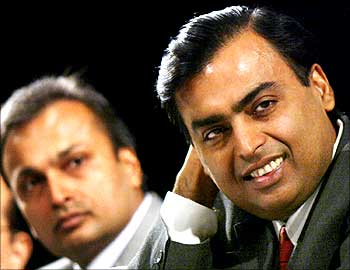
In peace and at war, firms remain tethered to promoter families in a uniquely Indian way.

The stimulus packages should continue for another year or at least till October 31, he said, pointing out that the economy is yet to achieve the pre-crisis level of nine per cent.

RIL, Capgemini, IndiGo among companies which have offered to pay their employees' vaccination cost.

India Inc on Thursday expressed fear that the RBI's decision to raise key short-term rates will push up the cost of borrowing, making some of their projects unviable and hurting expansion plans.
